
Face As Identity: Distortion in Postpartum and Self Portraiture
After giving birth to my son, I did not anticipate the “disappearance” of my face. I didn’t look in a mirror once during my long labor, emergency cesarean, or the day post-surgery. The first time I saw myself now as a mother was after limping slowly to the hospital bathroom for my first shower in days. My previous visits to the bathroom had been so laborious, hunched over my incision, that looking in the mirror was the very last of my priorities. This visit I felt well enough to pause and look in the mirror. I remember the moment distinctly—what I saw was not someone I knew. Yet I wasn’t afraid or sad or angry. I simply didn’t care. My face was no longer my own and it wasn’t important anymore. I spent more time gingerly washing and exploring my cesarean incision than looking at my face. I registered every staple, tape, and dried blood drip in my memory.
After giving birth to my son, I did not anticipate the “disappearance” of my face. I didn’t look in a mirror during my long labor, obviously not the emergency cesarean, or the day post-surgery. The first time I saw myself—now as a mother—was after limping slowly to the hospital bathroom for my first shower in days. My previous visits to the bathroom had been so laborious, wobbly, and hunched over due to the seven-layer incision in my abdomen, that looking in the mirror had been the very last of my priorities. This time I felt well enough to pause and look in the mirror. I remember the moment distinctly—who I saw was not someone I knew. Yet I wasn’t afraid or sad or angry. I simply didn’t care. My face was no longer my own and it wasn’t important anymore. I spent more time gingerly washing and exploring my cesarean incision than looking at my face. I registered every staple, tape, and dried drip of blood in my memory.
In the following days of early postpartum, I began to see my son’s face in my reflection. That made more sense—he was me and I was him. I saw his face everywhere during those foggy, early days. It was the same sensation as when you look at the sun for a second, and the bright orb gets imprinted in your vision for a bit. His face was everywhere—in my dreams, in the sky, and in my coffee.
My sense of self shifted to my role as his caregiver, and the body parts that I believed helped me fulfill that role best. My breasts, which provided his nourishment and comfort (both of which he sought endlessly), carried more value than my face. My cesarean was the vehicle that brought him into this world safely. My arms carried his body and held him close to me. I only recognized my face when my son looked back at me. In his bright eyes, ease, and joy—there I was.
I’m not sure I fully understood the distortion of self that had transpired when I was in the thick of it. But it’s so clear to me now when I look back at my self-portraits from the first year postpartum. None of my drawings included my face unless it was obscured by a toy or my son’s body or slightly cropped out of the composition. Instead, the self-portraits are details of us breastfeeding, our body parts intertwined, or my cesarean incision or scar. My body was a better reflection of what I was experiencing at that time, both emotionally and physically. Which was not only postpartum healing and mothering but also grieving for a father who died shortly after his cancer diagnosis and navigating the new and isolating normal of the COVID-19 pandemic.
It should be noted that the lack of postpartum support and resources in Western culture encourages the disappearance of a birthing person. They are isolated in their role (even outside of pandemic conditions) and often left to fend for themselves, while simultaneously being judged for their choices. This is a conversation for another time, but I often think about it.
I began to include my entire face in drawings about two years postpartum. But I don’t see familiarity in these. I look at them now and sense the tension of trying to reacquaint myself with my own face. Are these my eyes? No, they don’t look like that anymore. My eyelids are heavier now. During my son’s third year and now into his fourth, that familiarity has finally started to creep back into my sense of self and drawings. The charcoal portrait below is probably the first signal of that transition back to a place of recognition. Yet the composition is ironic given that the profile of my face is layered over my son’s, half of which is peaking out behind mine. It’s the perfect self-portrait for this time in our lives. We are no longer one and the same but are now three people—me, him, and we.
The following passage from MILK by Joanna Wolfarth perfectly captures this sensation and distortion of face and selfhood in early postpartum that I had struggled to pin down over the years. I highly recommend reading this book in its entirety.
“In many cultures, our face is our identity, our selfhood. But early motherhood was, for me, a time of distorted selfhood where I felt truly faceless. For the first five days of my son’s life, I don’t ever remember seeing or sensing my own face. And any physical sensation was entirely centered on the fullness in my breasts, the emptiness of my belly, and the bruising just below. Even when we returned home and I found time to glance in the mirror, my own face was gone, replaced by that of my son.” - MILK, Joanna Wolfarth
Did you experience this in your early days, weeks, or months after giving birth or becoming a parent? Feel free to share your experience in the comments or email me! I love talking about this stuff—our brains, body, and heart are wild.
Books, Books, Books
This summer I saw a meme that was something like, there is no one filled with more false hope than a parent who brings a book to the beach. Truer words…
As a typically avid reader, I did NOT read enough books in 2023—something I plan to remedy in 2024. Below is a cumulative list of books I’d like to read this year—and likely into 2025 because I am realistic about how much free time I have. I’ve also included books that I have read, bookmarked, and underlined in recent years. Mostly nonfiction, monographs, exhibition catalogs, essays, and social and cultural analyses with a theme of caregiving, creativity, community, and reproductive justice. In no particular order…
My “Want To Read” List:
Supervision: On Motherhood and Surveillance, edited by Sophie Hamacher and Jessica Hankey
Stranger Fruit, Jon Henry
The Archaeology of Mothering: An African-American Midwife's Tale, Laurie A. Wilkie
Architects of Care: From the Intimate to the Common, Brittany Utting
Women, Race, Class, Angela Y. Davis
The Art of Gathering, Priya Parker
Curating with Care: Routledge Research in Art Museums and Exhibitions, edited by Elke Krasny, Lara Perry
Queer Exhibition Histories, edited with text by Bas Hendrikx
The Mother Artist, Catherine Ricketts
Falling Back in Love with Being Human: Letters to Lost Souls, Kai Cheng Thom
Boobs in the Arts: Fe:male Bodies in Pictorial History, edited by Natanja von Stosch and Juliet Kothe
Art & Social Practice Workbook, by Erin Charpentier & Travis Neel
MILK: An Intimate History of Breastfeeding, Joanna Wolfarth
Art Monsters: Unruly Bodies in Feminist Art, Lauren Elkin
The Turnaway Study: Ten Years, a Thousand Women, and the Consequences of Having—Or Being Denied—An Abortion, by Diana Greene Foster
Care Work: Dreaming Disability Justice, Leah Lakshmi Piepzna-Samarasinha
Cousins, Kristen Joy Emack
Braiding Sweetgrass: Indigenous Wisdom, Scientific Knowledge, and the Teaching of Plants, Robin Wall Kimmerer
To Begin Again: Artists and Childhood, ICA Boston
Matrescence: On Pregnancy, Childbirth, and Motherhood, Lucy Jones
How Not To Exclude Artist Mothers (and other parents), Hettie Judah
Motherhood, by Ann Coxon
All About Love, bell hooks
Like a Mother, Angela Garbes
Reproductive Justice: an Introduction, Loretta J. Ross
Mothering While Black, Dawn Marie Dow
Everything She Touched: The Life of Ruth Asawa, Marilyn Chase
Loie Hallowell: Plumb Line, Loie Hallowell
An Artist and A Mother, edited by Tara Carpenter Estrada, Heidi Moller Somsen, and Kaylen Buteyn
My Kingdom for a Title, Pope.L
The Equity Mindset, Ifeomasinachi Ike
Hide, Wood, and Willow: Cradles of the Great Plains Indians, Deanna Tidwell Broughton
My “Read and 10/10 Recommend” List:
Art/Curation
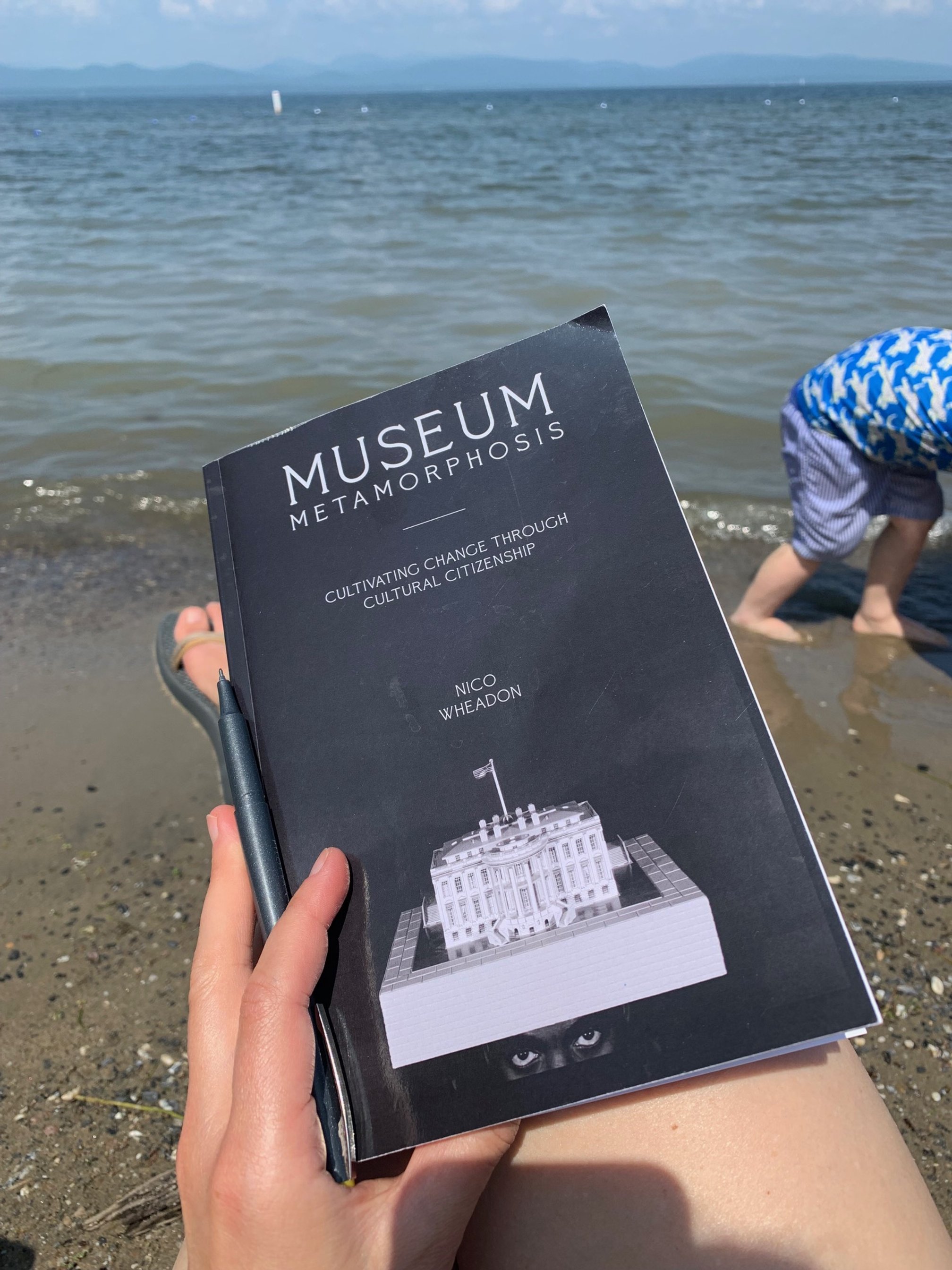
Museum Metamorphosis: Cultivating Change Through Cultural Citizenship, nico wheadon okoro
Teaching to Transgress: Education as the Practice of Freedom, bell hooks
Essential Labor: Mothering as Social Change, Angela Garbes
Radical Reproductive Justice: Foundation, Theory, Practice, edited by Lynn Roberts, Whitney Peoples, Erika Derkas, Pamela D. Bridgewater, Loretta Ross
Designing Motherhood, Michelle Millar Fisher, Amber Winick
Picturing Motherhood Now, Nadiah Rivera Fellah, Emily Liebert, Rosalyn Deutsche
Killing the Black Body: Race, Reproduction, and the Meaning of Liberty, Dorothy E. Roberts
Medical Bondage: Race, Gender, and the Origins of American Gynecology, Deirdre Cooper Owens
Revolutionary Mothering, edited by Alexis Pauline Gumbs, China Martens, and Mai’a Williams
Guidebook to Relative Strangers: Journeys into Race, Motherhood, and History, Camille T. Dungy
The Will to Change: Men, Masculinity, and Love, bell hooks
The Baby on the Fire Escape, Julie Phillips
The Blue Jay’s Dance: A Memoir of Early Motherhood, Louise Erdrich
Safe When You're With Me
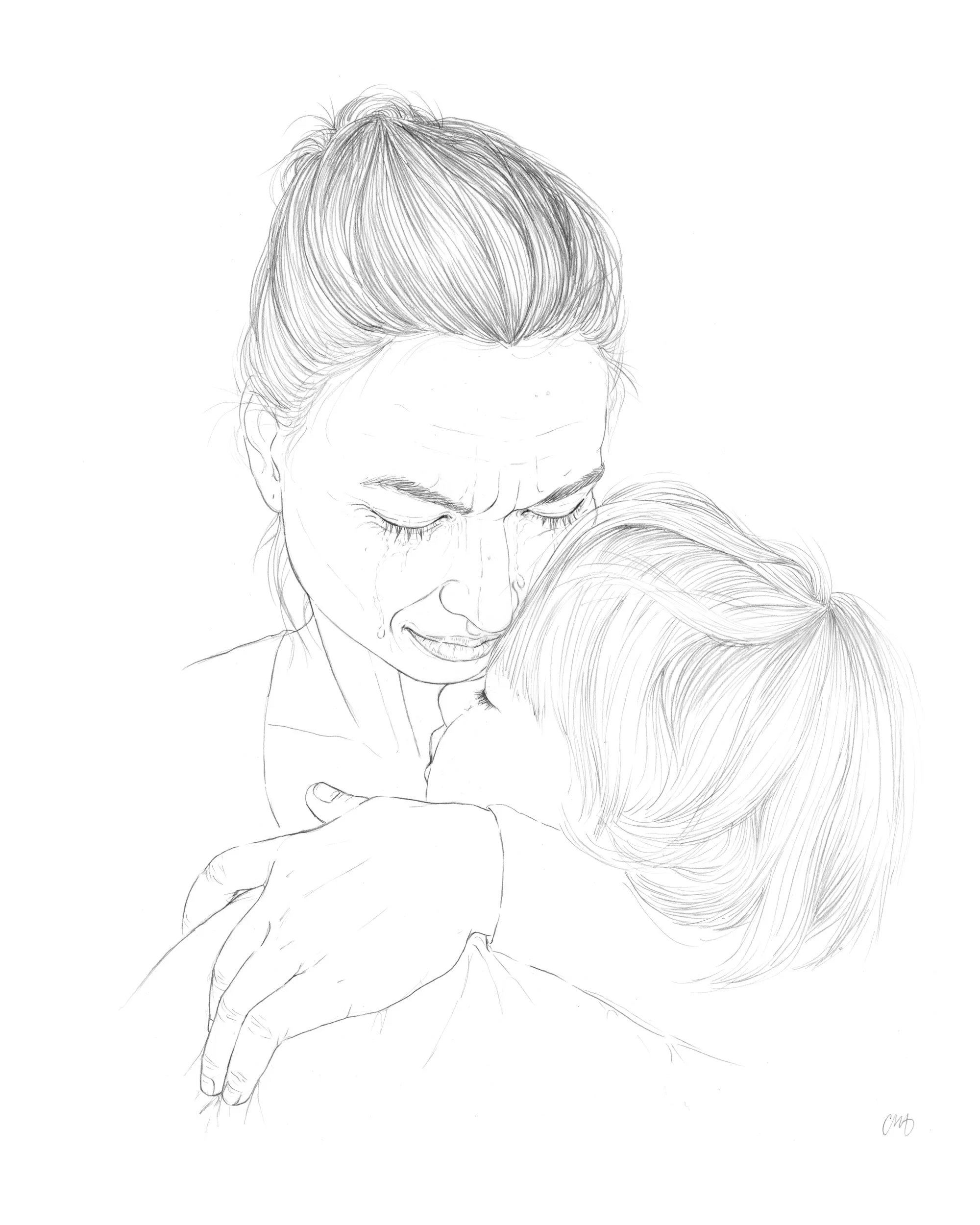
The weight of love is immense and heavy. We are most reminded of this when those we love are at risk of harm or we are at risk of losing them. With gun violence rampant in this country and threatening our children daily—in schools, at grocery stores, at parties, in homes—that weight feels unbearable and exhausting.
The death of loved ones is familiar territory for me. So when my son was born, nightmares of losing him followed almost immediately. Vivid dreams of losing him in crowded places, devastating fires in our home, car crashes, and bizarre accidents I couldn’t even recall when I bolted awake. What I could recall was that in each of them, I had no control over the situation or I wasn’t with him. I know so many parents and caregivers who also feel this lack of control… and not just in their dreams. Clinging to your child’s tiny body in a tight embrace, afraid to let go at the door of their classroom. When your teen’s high school alerts you of another active shooter drill. Or worse, of a potential threat. Knowing that they’ll be walking to band practice like they do every day… but will today be different? We worry about our children constantly, especially when they are not with us. My own fears are often fueled by the question, if my son is not with me, how can I keep him safe? Spaces in our community that are designed to be and should be safe, like schools, no longer feel so. And the rhetoric of, “What’s the likelihood of it happening to you?” is rapidly losing its potency for calming our (valid) nerves.
The weight of love is immense and heavy. We are most reminded of this when those we love are at risk of harm or we are at risk of losing them. With gun violence rampant in this country and threatening our children daily—in schools, at grocery stores, at parties, in homes—that weight feels unbearable and exhausting.
The death of loved ones is familiar territory for me. So when my son was born, nightmares of losing him followed almost immediately. Vivid dreams of losing him in crowded places, devastating fires in our home, car crashes, and bizarre accidents I couldn’t even recall when I bolted awake. What I could recall was that in each of them, I had no control over the situation or I wasn’t with him. I know so many parents and caregivers who also feel this lack of control… and not just in their dreams. Clinging to your child’s tiny body in a tight embrace, afraid to let go at the door of their classroom. When your teen’s high school alerts you of another active shooter drill. Or worse, of a potential threat. Knowing that they’ll be walking to band practice like they do every day… but will today be different? We worry about our children constantly, especially when they are not with us. My own fears are often fueled by the question, if my son is not with me, how can I keep him safe? Spaces in our community that are designed to be and should be safe, like schools, no longer feel so. And the rhetoric of, “What’s the likelihood of it happening to you?” is rapidly losing its potency for calming our (valid) nerves.
One day last year at daycare pickup, my son was surprised to see that my car was parked in a different spot than when I dropped him off that morning. I believe it was the first time he noticed and realized that his mama had not been waiting for him outside the building while he was enjoying his day with his class. That his mama must leave and if so, where does she go? I told him that I work on my laptop from home or at the library and that sometimes I go to a meeting with a client somewhere else, like the coffee shop with those blueberry muffins he likes. I assured him that every day I’m so excited to come back to pick him up. I didn’t tell him that I spend most days with worry buried in every crevice of my brain. Our conversation reminded me of Margaret Hass’ poem, “First Day of Kindergarten.” There are days when I have a hard time driving away from his school’s parking lot, my hands tense and gripping the steering wheel. If the worst thing imaginable did happen, I am plagued by the fear that I won’t be there to hold him close to my body. To look into his eyes and tell him that he is loved and that I will never leave his side, no matter what comes. To tell him that a life without him is not worth living (recommended reading: Kate Baer’s poem “Back to School Shopping”).
For many parents, these fears and worries are aggravated and compounded. Black and brown children cannot do even the simplest daily activities—like picking up their siblings or attending a birthday party—without the threat of violence. Black boys especially are treated as adults and as a potential threat from a very young age. Not as the children that they are and have a right to be. Even in the womb, their parents are denied the same quality of care and respect that white birthing people and infants receive. This systemic racism results in higher maternal and infant mortality rates for Black birthing people and babies. NBEC is only one of many resources for learning more about this and why Reproductive Justice (introduced by Black women) is so important.
Since the start of the year, 400+ anti-LGBTQ+ bills have been introduced. Many of these target transgender youth directly with legislation that restricts or denies their access to health care, human rights, and safety. So often, when an identity like transgender or Black is before the word “child”… then they are no longer treated or cared for as children. The innocence of youth and childhood is denied to them. In a recent SNL episode, Molly Kearny (the first nonbinary cast member) called out the hypocrisy of anti-trans legislation and sentiments, “If you don’t care about trans kids’ lives, it means you don’t care about freakin’ kids’ lives.” She goes on to speak directly to trans kids through the screen and assures them that their job is to simply be kids… and that our job as adults, is to care for them.
Nothing will change if we continue to take action in ebbs and flows, participating in bursts of “awareness” and news cycles. It is our collective responsibility as adults—whether you’re a parent or not—to DEMAND their right to safety in all environments, to health care, to affirm their identity, and to foster equitable access to resources like quality education and child care. It is also our responsibility to raise our own children to not just be kind but to respect and care for each other. All kids have a right to a childhood. This is our responsibility.
Early Riser
My toddler is an early riser. A 6:30 am wake-up is a relief when it happens. More often than not we’re stumbling down the stairs at 5:00, me reaching for the Chemex before anything else. My son knows the routine, "mama, mama, get your coffee, and then let's read a book." On mornings when he wakes fitfully with a cry for mama before 5, I do my best to convince him that we should sleep a little longer. I'll invite him to cuddle with me on the couch in the living room.
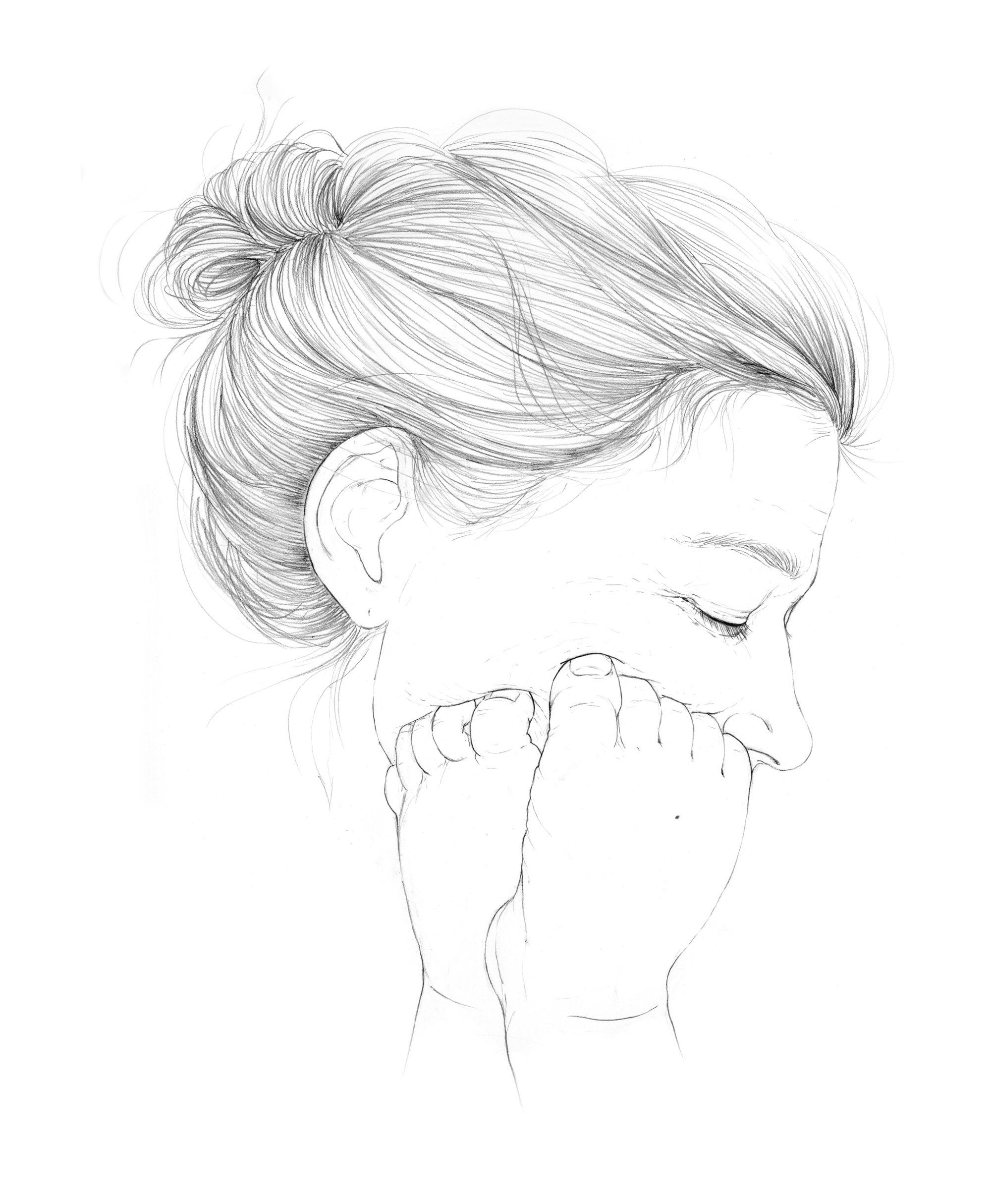
My toddler is an early riser. A 6:30 am wake-up is a relief when it happens. More often than not we’re stumbling down the stairs at 5:00, me reaching for the Chemex before anything else. My son knows the routine, "mama, mama, get your coffee, and then let's read a book." On mornings when he wakes fitfully with a cry for mama before 5, I do my best to convince him that we should sleep a little longer. I'll invite him to cuddle with me on the couch in the living room. On the rare occasion—like when he's sick—he'll fall back asleep, his warm body imprinted into mine and his soft breath puffing into my face. Most of the time it's his body dancing on mine as I try my best to model a good snooze. Legs kicking up and down, arms squirming underneath and over, sitting on, rolling on, climbing on, feet in face. This drawing is one of those mornings.
I am actually a morning person (my partner is decidedly not). About a month ago, I made the conscious decision to try and tap back into why I loved mornings pre-kiddo (in an effort to feel a little less whiny myself). I would often take my cup of coffee outside and feel the quiet of morning, gaze at the moon above, or watch the morning mist disperse to reveal a warm sunset. I used that uninterrupted time to draw or write. So while mornings can’t be sound or interruption free with a toddler, we’ve been going outside first thing when we wake up. "Look at the moon, mama!" he squeals with delight as we look up to the cold winter sky.


Vivamus pellentesque vitae neque at vestibulum. Donec efficitur mollis dui vel pharetra.